
Compare Glynn County Value Types
One Glynn County parcel can carry several values, and every label matters. Read each figure with its year. Fair-market value is the county's full estimate. Assessed value reflects the level Georgia law sets. A sale amount documents a past deed transaction, while taxable value shows the result after exemptions.
| Value type | Meaning | Official record |
|---|---|---|
| Fair-market value | County estimate of full value for the year | Property Appraisal/QPublic |
| Assessed value | Forty percent of fair-market value before exemptions | Assessment and tax record |
| Taxable value | Assessment remaining after applicable exemptions | Tax bill |
| Last sale price | Amount tied to a dated transfer | Deed index/image and parcel card |
The Georgia Department of Revenue explains the 40 percent assessment ratio. Exemptions apply after that step. Assessed and taxable values diverge as well.
A fair-market figure comes from the assessor's annual valuation work. A last sale amount comes from a dated deed event. Neither can stand in for the other. Name the value type in notes, spreadsheets, and records requests. Nobody then mistakes the smaller assessed figure for full market value.
Split Glynn Land and Improvements
A populated Glynn County QPublic card separates annual land value, improvement value, and total value. It also shows the assessed value. Land reflects the site itself. Improvements cover taxable structures. The total combines both parts for the year shown.
Compare the same labeled year across parcels. A coastal tract and an improved city lot can reach similar totals. They can do so for very different reasons. The split explains the record. It says nothing about repair costs or construction quality at appraisal depth.
Acreage, property class, neighborhood, zoning, and tax district add useful context alongside the component values. A change in the total may come from land, improvements, a parcel reconfiguration, or a new assessment. A single headline number never tells the whole story.
Note: A sample card is a field inventory, and not every field appears for every Glynn parcel.
Estimate Glynn Value from Records
The Glynn County QPublic search accepts owner, address, parcel, and legal-information routes. Address matching works from a house number and street prefix. Once a result appears, confirm the situs, parcel number, legal description, and tax district before relying on any value figure.
- Search the address or parcel key and verify the land identity.
- Record the year, land, improvement, fair-market, and assessed amounts.
- Note exemption fields before comparing taxable value.
- Read sale date, deed type, book/page, and consideration as a separate transaction.
- Assessed value
- The statutory share of fair-market value before exemptions.
- Market value
- The assessor's full-value estimate for a stated year.
- Assessment ratio
- The percentage converting fair-market to assessed value.
- Consideration
- The amount stated or indexed for a conveyance.
- Reassessment
- A new value determination for an assessment period.
Save or print the result with its retrieval date. The live QPublic card changes over time, and field order or refresh details can vary by parcel. Describe what the assessor card displays rather than assuming every parcel exposes the same controls or the same historic depth.
Read Glynn Sale Prices
A Glynn County parcel card can show sale date, amount, deed type, and book/page reference. GSCCCA adds parties, instrument type, location, and the recording reference. A sale price belongs to that one transaction. It may involve unusual terms, several parcels, or an estate. It may also be a deed that never reflected an open-market sale.
Read the deed image and legal description before drawing conclusions. A consideration figure is not automatically the present property value. Keep the sale date with it, because markets and parcels change.
Deed types matter here. A quitclaim, executor deed, foreclosure-related deed, or transfer among related entities may carry a weaker market signal. An arm's-length warranty deed carries a stronger one. The index label is a prompt to inspect the recorded image, not a valuation verdict.
Separate Glynn Taxable Value
Exemptions can reduce taxable value without erasing fair-market value. Glynn's homestead rule focuses on ownership and use as of January 1, with a general April 1 deadline. An exemption code affects tax treatment, not the physical worth of a building.
The county's homestead eligibility page documents that official distinction.
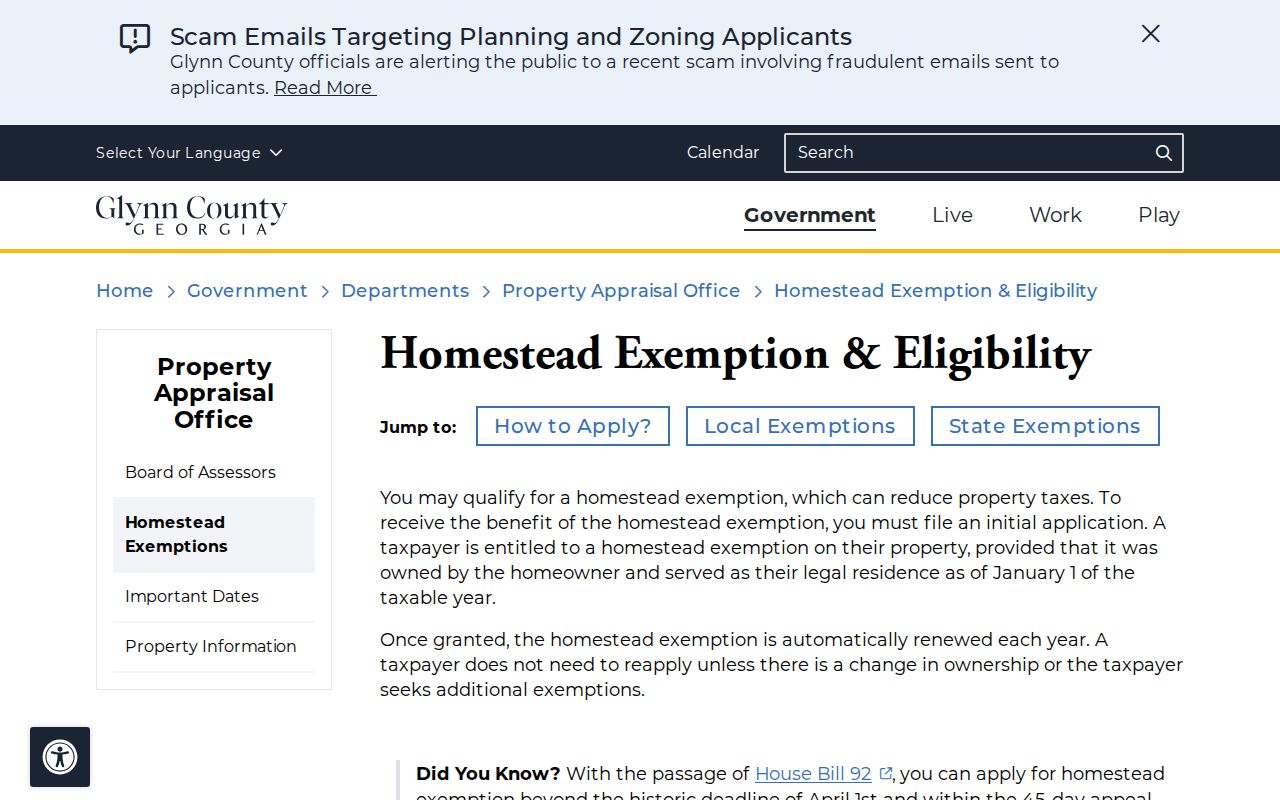
That homestead page also explains why two Glynn County parcels with the same assessed value can carry different taxable values without implying different market estimates.
Glynn County stayed in the HB 581 framework in 2025 and stated that the Scarlett-Williams exemption was unaffected. Compare value-freeze and homestead fields by year. The property tax page covers bills and appeals.
Date Glynn Assessment Figures
The county calendar uses January 1 for property use, condition, and value. Notices generally follow in May and June. A 2026 county guide addressed value changes, exemptions, and preserving the notice date. Always cite the actual year.
A tentative millage proposal does not change what assessed value means. Millage affects the tax calculation, not the appraisal field. Keep proposed rates separate from a settled parcel record.
When a value changed, compare the prior and current assessment cards, the notice, parcel characteristics, and any recent sale. Note whether land, improvements, or both components moved. That comparison describes the public record; it does not judge whether the county's method was correct.
Use Glynn Sales Context
QPublic lets you sample recent sales by area, date, neighborhood, subdivision, or distance. Treat these as leads. They are not a valuation model. Before using another transfer as context, match property class, land area, improvements, sale date, and location carefully.
Layout history matters here as well. Windsor Park curves. Dixville sits on a narrow grid. Parcel shape and development era can help explain value components. Neither one sets a price on its own.
Coastal, island, marsh, city-grid, and mainland parcels share county custodians. Yet they differ sharply in access, lot form, zoning, and improvements. Pick comparison sales by property traits and geography. A Brunswick postal label or short radius alone is not enough.
Work through the whole result set instead of grabbing one convenient transaction. Flag transfers with odd deed types. Also flag multiple parcels, nominal consideration, family or entity ties, or big gaps in acreage or building class. Then set the assessor's neighborhood and subdivision fields beside the map. These checks will not produce an appraisal. But they keep a weak sale from standing in as a direct measure of the subject parcel.
Timing adds its own gap. A recorded price belongs to its closing. The assessment, meanwhile, states value for the county's January 1 valuation date. Improvements, lot splits, market conditions, and exemptions can all shift between those dates. A sound summary names both dates. It never treats a later tax card as proof of what held true at an earlier sale.
Limit Glynn Property Value Claims
An assessed value exists to support tax administration. It is not an appraisal, an offer, a guaranteed sale price, or a title opinion. GIS lines are reference data rather than a survey. Always state the value type, year, parcel, and source.
For tax bills, exemptions, and appeal procedure, turn to the Glynn County tax records. Those processes sit apart from reading value fields.
When a parcel card looks wrong, separate a factual correction from a valuation dispute. Document an incorrect acreage, property class, or improvement entry for Property Appraisal. A valuation challenge goes through the notice and appeal process. Neither route changes the last recorded sale price. That figure stays a historical transaction field tied to its deed and date.
Value limit. Assessed value is for taxation and is not what the property would necessarily sell for in the current market. It is not an appraisal.