
Fields Inside Glynn County Property Tax Records
Every Glynn County property tax search runs through two records. It starts with the county appraisal card. It ends with the bill record. The card carries the assessment year, land and improvement values, and total fair-market value. It also lists assessed totals, homestead flag, tax district, property class, acreage, and millage. The tax portal handles the administrative side. It shows the name and address used on the statement, the bill amount, payment status, and any inactive flag on the parcel. Check the year on every screen before comparing amounts across the two systems.
| Field | What It Shows | Where |
|---|---|---|
| Fair-market value | County appraisal estimate before the statutory assessment ratio | Property Appraisal / QPublic card |
| Assessed value | Georgia taxable assessment basis, generally 40% of fair-market value | Property Appraisal / QPublic card |
| Exemptions | Relief applied before taxable value is calculated | Appraisal card and notice |
| Bill and status | Charge, balance, payment, or inactive-account warning | Tax and Revenue portal |
| Tax district | Jurisdiction used to apply the relevant levies | Appraisal card and bill |
A Glynn County bill separates fair-market value, a 40% net assessment, exemptions, taxable value, and the taxing authorities. Those figures measure different things. A bill is not a sale price. An assessed value is not an independent appraisal. For a closer look at those distinctions, see the Glynn County property value guide.
Search Keys for a Glynn County Property Tax Account
The official tax and revenue portal offers several routes to the right account. Search broadly only when you must. Then confirm the location and parcel data on the result before trusting it. A name alone is weak evidence. It may reflect the January 1 owner. Or it may simply name a mailing recipient. The PIDN and map/parcel fields are stronger bridges back to QPublic and the GIS map.
| Portal field | Best use | Check before relying |
|---|---|---|
| PIDN | Exact parcel-account search | Preserve leading zeros and punctuation |
| MAP / Parcel | Cross-check a map-based identifier | Do not assume it equals PIDN |
| Name on Statement | Find the billed account name | Compare assessment year and location |
| Mailing Name | Locate an account by notice recipient | Recipient may not be current title owner |
| Location Address / Street | Everyday address lookup | Try street prefix and review near matches |
An inactive warning is not a dead end. Record it, then hunt for a successor parcel or a split or merger. Inactive means the identifier needs one more step, not that the land is ownerless or tax-free.
Look Up a Glynn County Property Tax Bill
Establish identity before reading the bill. Glynn systems can display PIDN, parcel number, and map/block-lot in different formats. Keep all of them. That habit keeps a bill from attaching to a similarly named owner, a neighboring parcel, or an old parcel number.
- Search QPublic by address, owner, or parcel, and copy the situs address, PIDN or parcel number, map/block-lot, tax district, and assessment year.
- Open the Glynn Tax and Revenue portal and search the strongest identifier. Use location address or street when no parcel key is known.
- Read the bill year, statement name, charge, balance, and payment status. Keep a copy of any inactive-account warning.
- Return to the appraisal card and notice to check the value components and exemptions used for that same year.
- If delinquency or sale is a concern, verify it with the Tax Commissioner and recorded Clerk documents instead of inferring it from a balance alone.
- Assessed value
- The statutory assessment base derived from fair-market value.
- Mill rate or levy
- The rate applied by a taxing authority to taxable assessed value.
- Homestead exemption
- Qualified relief tied to ownership and occupancy requirements.
- Tax lien
- A claim securing unpaid property tax, which requires official verification.
Why the January 1 Name Matters in Glynn County
The Tax Commissioner sends bills to the January 1 owner of record. It does not send them to mortgage companies. A midyear buyer can therefore open a bill and see the prior owner's name. That can happen even after a deed has recorded. Mailing addresses add their own twist. The county may list a post-office box, agent, trust, or office rather than the parcel itself. Use the situs address to identify the land. Use the mailing address to see where notices go.
When ownership changed during the year, set the latest recorded deed beside the appraisal card and the bill. Never rebuild a chain of title from the tax screen alone. A closing statement may divide the year's taxes between buyer and seller. That private allocation does not rewrite the county's January 1 billing record. Keep the closing paper as transaction evidence and read it apart from the public account.
If a notice went to an old address, ask the appraisal and tax offices which mailing field must be corrected. Ask also what proof they require. A corrected mailing line still settles nothing in a deed dispute.
Glynn County Homestead Dates and Exemption Evidence
Glynn County's eligibility page ties homestead status to ownership and occupancy as of January 1. The county calendar sets April 1 as the filing deadline. The appraisal record's homestead flag is a useful check, but the governing office should confirm eligibility and the code actually applied.
Keep the application or confirmation, assessment notice, and bill for the same tax year. If an expected exemption is absent, contact the Property Appraisal Office before assuming the tax portal made a calculation error. Georgia and local exemption types have distinct requirements and cannot be reduced to a generic age or residency rule.
Brunswick Property Tax Has a City and County Split
Brunswick is Glynn County's only incorporated municipality. Its Tax Department levies and collects city real and personal property tax inside municipal limits. Glynn County, meanwhile, handles countywide valuation and maintains the county record systems. So an inside-city parcel can carry both city and county tax records. A Brunswick mailing address alone proves nothing about boundaries. Confirm the line with the parcel map. Check the tax district before applying any city tax rule. St. Simons Island and Jekyll Island sit outside the city. The other Golden Isles communities are not separate incorporated cities for this purpose.
Glynn County Tax Digests Reach Beyond Current Bills
Current portals answer current-account questions. Older research follows a different trail. The Georgia Archives retains permanent property cards and tax digests under its local-government schedule. Its digital tax collection includes a Glynn County tax digest from 1792, an unusually rich name and land clue for work that predates modern parcel numbers. An old digest entry is not a current assessment card, though.
Record the taxpayer or landholder name, district, acreage or land description, value or tax, and page context. Then pair those facts with deeds, plats, and later digests. That method keeps a historical tax clue from being mistaken for title proof.
Delinquent Glynn County Property Tax Needs Separate Proof
A balance on the screen is only a lead. It cannot prove a tax sale or a change in ownership. Glynn County runs its tax sales online. The county has published material covering tax deeds, premiums, and a 12-month redemption period in the county-held tax-deed context.
Before acting, confirm the parcel number. Confirm the sale notice, sale date, purchaser, redemption status, and any instrument the Clerk has recorded. A scheduled sale can still be paid or withdrawn. And even a recorded tax deed is no substitute for a full title review.
Check the Glynn County Tax Commissioner page before settling on a bill. Pick the payment or delinquency route after that.
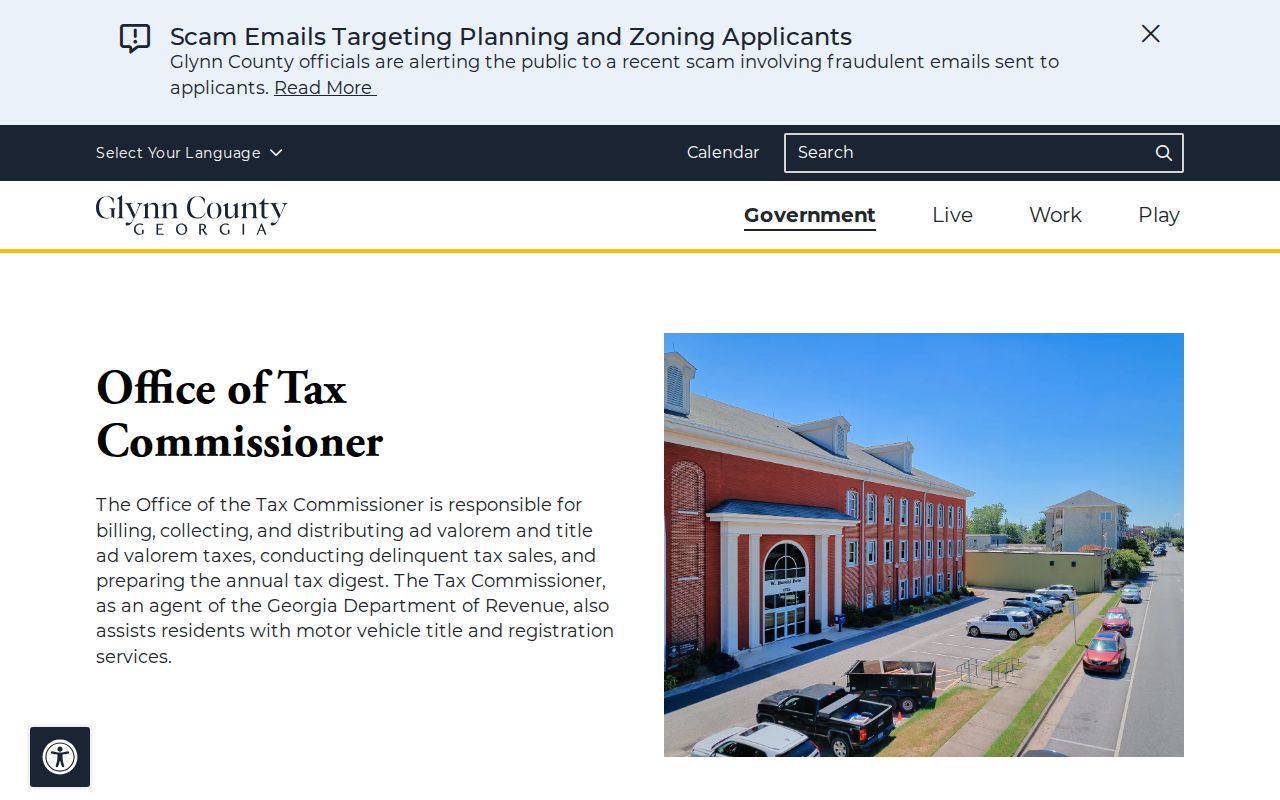
The county's official page supplies the starting point. The parcel account and current notices supply the property-specific facts, from delinquency amounts to pending sale action on the parcel in question.
Contest a Glynn County Property Tax Assessment
An appeal attacks the assessment itself. Glynn County routes written appeals through its appraisal staff and the Board of Equalization. The published summary allows 45 days from the date on the assessment notice. It bars filing by email or fax. Grounds can include value, uniformity, taxability, exemption denial, or a breach of covenant. The exact ground depends on the parcel.
Gather your evidence early. Save the notice envelope and its date. Include the parcel card, photographs, comparable records, and any deed or appraisal documents. The Board of Equalization page walks through the hearing and the further Superior Court route. For the current year, check the 2026 county notice guide. Do not rely on an older calendar.
Build comparables around the same valuation date. Explain the differences in lot size, improvement type, condition, location, and use. Uniformity evidence should name the records compared and the fields used. Nearby asking prices alone will not carry it. Keep proof of timely delivery, since the filing clock starts on the notice date. If appraisal staff revise a value during review, hold on to the revised notice. Confirm whether a hearing step still applies.
Appeal window. File the written appeal within 45 days of the assessment notice date and follow the county's delivery instructions.