
Trace Glynn Owners Backward
Start with the newest deed. The grantee received the interest while the grantor held it before. Search that grantor as an earlier grantee, then repeat. Carry the instrument type and legal description forward, because a name and date alone cannot show two records concern the same parcel.
| Transfer date | Grantor to grantee | Deed type | Book/page |
|---|---|---|---|
| Newest first | Prior owner to present grantee | Read exact indexed type | Capture from GSCCCA |
| One step earlier | Earlier seller to that prior owner | Warranty, quitclaim, or other type | Capture from cited deed |
| Earlier transfer | Repeat with the prior grantor | Include estate or foreclosure form | Preserve volume reference |
| Pre-index era | Names in deed books and tax digests | Historic conveyance | Clerk or Archives citation |
Note: Treat this timeline as a working record, not a title opinion.
Save the exact spelling and role of each former owner. A Glynn County deed index may list several grantors or grantees. Estates, trustees, and entities can sit between personal owners. Never collapse those parties into one seller. Security deeds and liens belong in the file too. Few of them mark a real change in ownership. Missing spouses, boundary shifts, and corrective deeds can also interrupt a tidy sequence.
Use Glynn's Deed Index
The GSCCCA Real Estate Index covers Glynn County deed records. It searches by name, property, subdivision, unit, block, lot, book and page, date, party type, and instrument type. Statewide index data reaches back to at least January 1, 1999. Coverage grows over time. Glynn County states no firm local cutoff. When a previous-owner search misses, coverage may be the cause.
Search each former owner as both grantor and grantee. Keep entity suffixes and try name variants. A no-hit can stem from name order or instrument category. The Clerk's terminal, office staff, and deed books remain the fallback. Clerk staff can explain a book series, archived file, recording correction, or copy certification when an online result falls short.
Coverage limit. GSCCCA reaches at least 1999 statewide, but Glynn's exact local imaging cutoff is not published; check deed books and archives.
Reconstruct Glynn's Deed Chain
Anchor the work to a known parcel. When street numbers or parcel IDs change, the legal description is the bridge, and the Clerk's property-record route offers local index help and archived material.
- Find the current acquisition deed and record its grantor, date, type, book/page, and legal description.
- Search that grantor as a grantee in an earlier period. Match the land before adding the transfer.
- Repeat, checking quitclaims, estate deeds, foreclosure forms, and corrective instruments.
- At the online boundary, ask the Clerk for the deed book or use Archives and FamilySearch.
- Grantor
- The party conveying an interest.
- Grantee
- The party receiving an interest.
- Chain of title
- The linked sequence of ownership instruments.
- Reverse index
- An index used to trace parties in the opposite role.
- Quitclaim
- A deed conveying whatever interest the grantor has without warranty promises.
Keep a research log. Note the search dates, name variants, index mode, county, instrument filter, and negative results beside the chain. A miss in a portal is not proof. The log keeps a later searcher from concluding a transfer never happened.
Bridge Glynn Parcel Changes
A modern APN did not exist for most of Glynn County history. Splits and subdivision phases replace parcel keys. So compare subdivision, lot, block, district, acreage, adjoining owners, and plat references instead. Historic lot lines and easement layers in the GIS map offer leads.
The map is not the chain. Pull the recorded plat and deed. Windsor Park's 1927 plat and 1929 layout explain its curving lots. Dixville's narrow lots and alleys trace an older grid. Neighborhood form is a search key, never ownership proof.
If acreage or lot wording changes, inspect an amended plat, combination, dedication, or boundary agreement before assuming the prior owners are unrelated. Carry both parcel keys forward. The retired one matters as much as the present one.
Enter Glynn's Early Record Era
Glynn County is different. It breaks the usual early Georgia deed-book pattern. The Georgia Archives Colonial Conveyances hold recorded private transactions from 1776 through 1785. Start colonial, since an ordinary 1785 or 1786 county series can miss earlier evidence.
The Archives also catalogs a 1792 Glynn tax digest. Those entries predate parcel numbers. Search by landholder, district, acreage, adjoining owner, and tax value. Then bridge the hits to later deeds and plats. An old tax entry is evidence, not a modern title record.
The Georgia Archives tax collection offers the official digital route to these older clues.
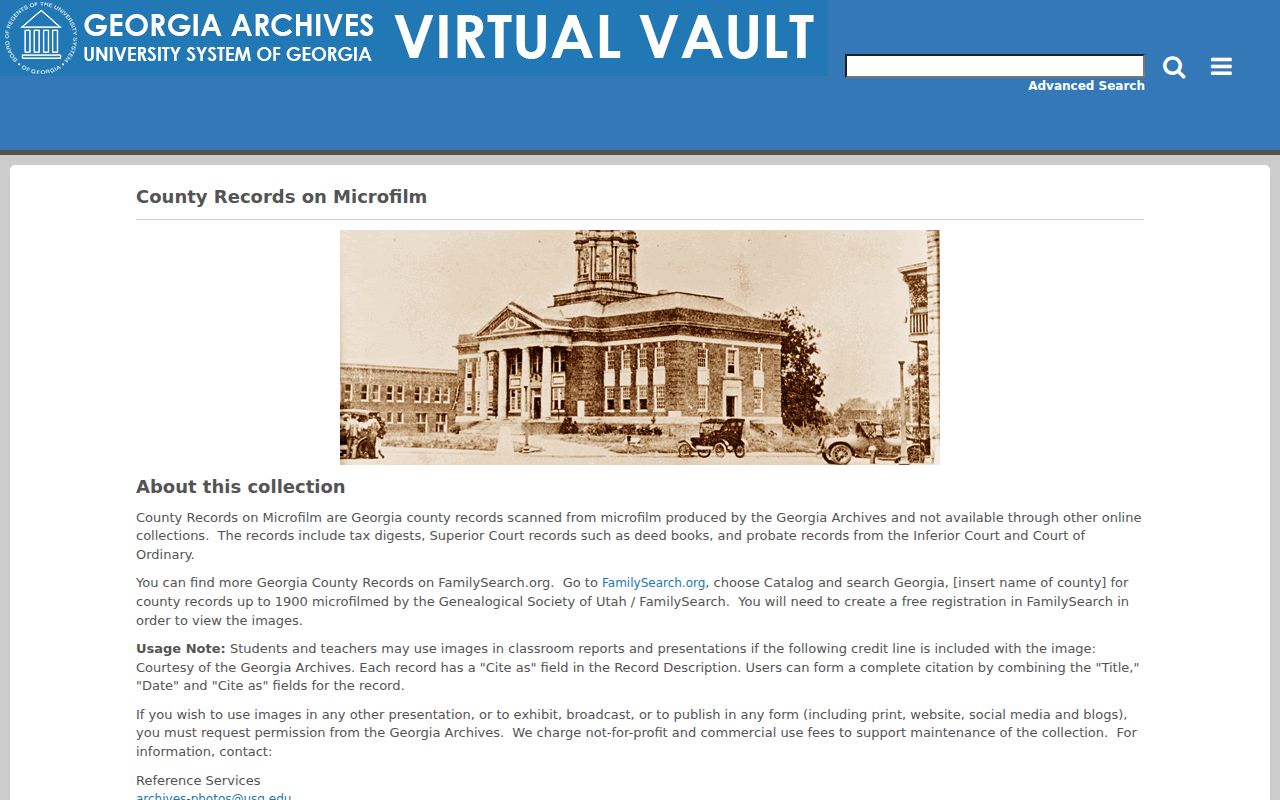
The archives portal opens a separate historical channel. It reaches periods that current parcel and deed portals no longer cover.
Fill Brunswick's Archive Gap
Brunswick's municipal archive shows a documented gap from 1843 to 1855 after its charter was lost. The county deed trail never vanished. For a city lot in those years, look wider. Combine county deeds and plats, Georgia Archives tax records, newspapers, cemetery deeds, and church sources.
Keep the city-lot, ward, street, or square wording intact. Brunswick reincorporated in 1856, and later sources may use different labels. Document any gap by record series and date. Skip the courthouse-fire tale unless a record supports it.
Name the substitute source beside every conclusion. A county deed, tax digest, cemetery deed, or newspaper notice carries its own evidentiary role and date span. None of them silently repairs a missing municipal volume.
Pair Glynn News with Deeds
Old newspapers can crack a Glynn County ownership puzzle. GALILEO's Brunswick papers span 1837 to 1932. The searchable Brunswick News archive covers 1917 to 1982. Search prior-owner names, initials, estate terms, tax sales, executors, subdivisions, lot and block, and old street spellings. A printed notice is never a conveyance. Note its date and page. Then pull the actual deed, court order, or tax instrument to confirm the transfer. The Brunswick-Glynn Heritage Room holds directories, maps, photos, and genealogy sources whenever an address needs more context.
Directories and advertisements help separate people who share a surname by occupation, street, or business name. Probate and foreclosure notices may name an estate representative, lender, or sale date worth testing in the deed index. Treat each newspaper spelling as a lead. Try initials, reversed names, former street terms, and the recorded subdivision before accepting a match.
Compare the paper's publication date with execution and recording dates. Those dates answer different questions. A notice may precede a sale or summarize it afterward, while the recorded instrument gives the parties, deed type, book and page, and legal description that attaches a former owner to the land.
Measure Glynn Ownership Depth
No single portal traces every former Glynn County owner. Modern transfers live in QPublic and GSCCCA. Older transfers move to Clerk deed books, microfilm guides, Georgia Archives collections, plats, and tax digests. Work in the eighteenth century may call for Colonial Conveyances plus headright or bounty plats. Record each source's real coverage and each gap. A digest or directory mention is not a deed. For a single document instead of a chain, use the Glynn County deed records page.
Keep a full research log. Log negative searches and why each next source was chosen. Glynn's exact online imaging cutoff is unpublished. The log separates an index limitation from a real break in the chain, and it hands the Clerk or an archive a precise book, period, party, and land description to investigate.
Chain limit. A reconstructed history supports land research, but it is not a title opinion. Never use former-owner records to harass or target a living person.